
The Settlement That Never Sleeps
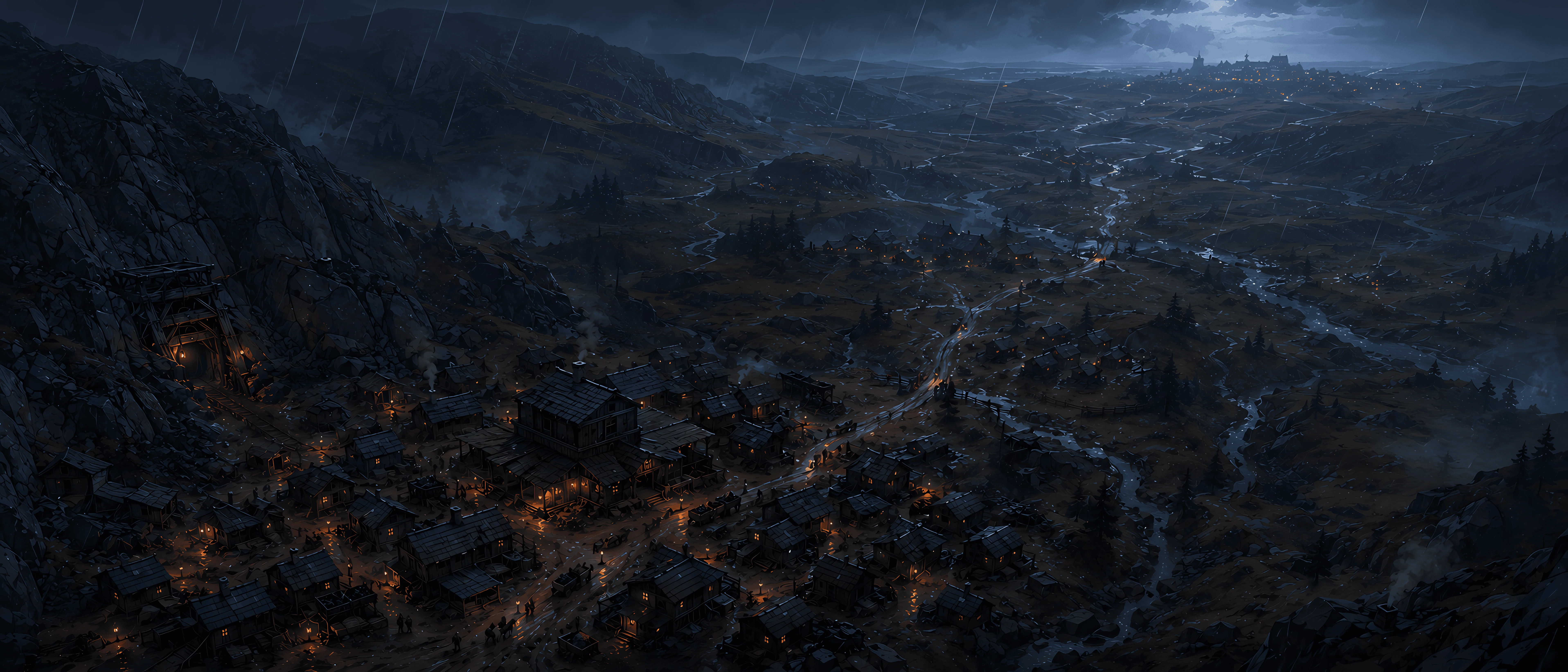
The settlement of Graven knew no quiet.
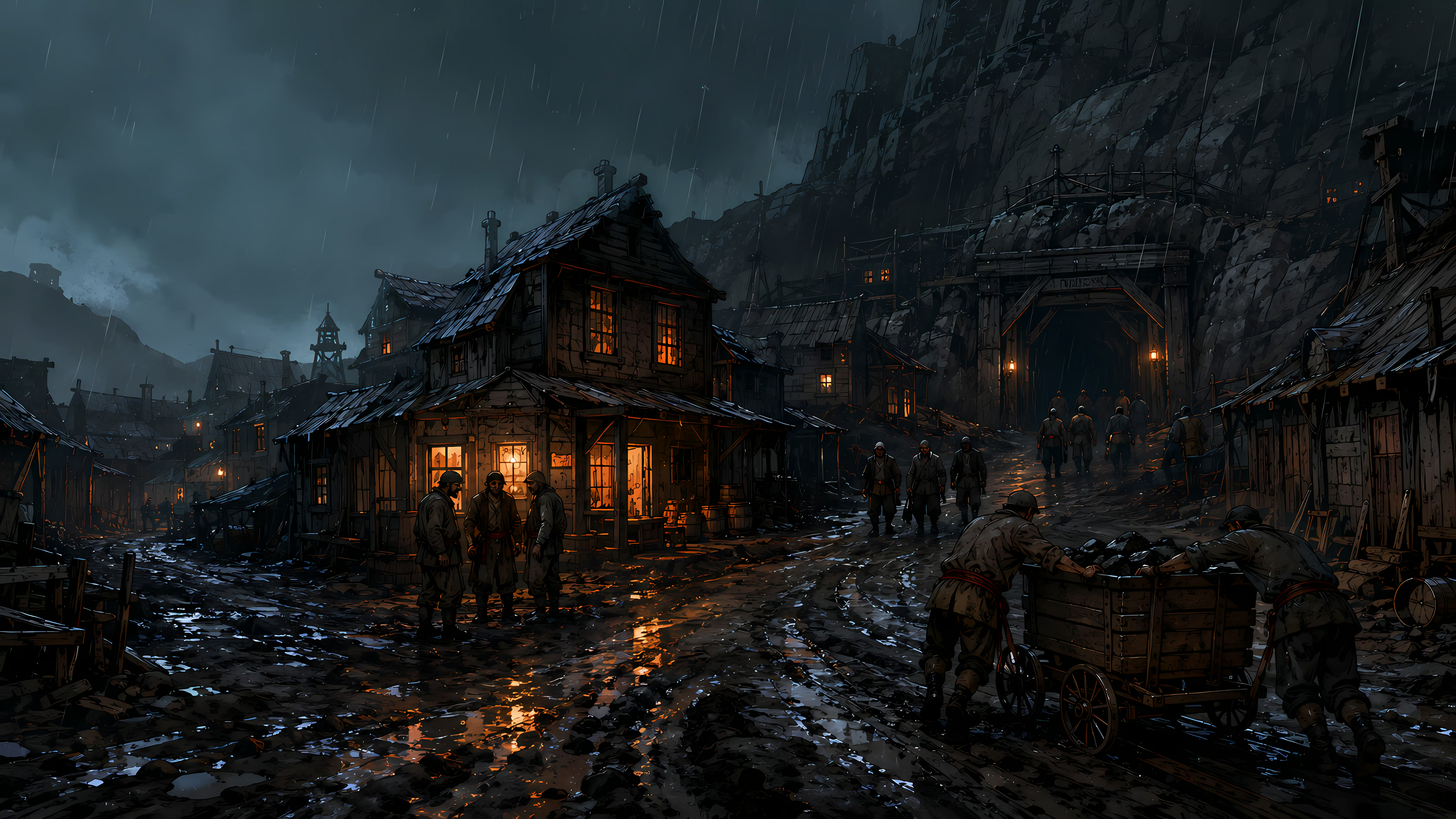
Even at midnight, the sound of picks and carts came from the mine. One shift ended and another took its place. Dozens of workers emerged with faces blackened by dust while others descended into the tunnels before the tools had time to cool.
The settlement belonged to the noble merchant Lord Edric Valmer.
He had not visited it in years, yet he received its entire yield: silver and lead ore, the fees deducted from the workers’ wages, and the rents on houses built in the first place to keep them close to the mine.
Every hour in which digging stopped meant fewer carts, less metal, and smaller profits.
So the work never stopped.
Graven lay in a region where rain fell on most days of the year. The usual rain was light, but it lasted for long hours, sometimes throughout the day. Weeks could pass in which the sun appeared for only a few minutes between the clouds.
The people of the settlement cared little. They were used to damp clothes, mud, and the smell of timber that had not dried in years.
Then, one night, the rain came down with unusual force.
It hammered the roofs, flooded the lanes, and turned black ore dust into thick mud. The drainage channels overflowed, and the water rushed toward the eastern road, carrying whatever it had swept from the edges of the settlement.
Graven was not a true village.
There was no public square, no market, and nowhere to sit or seek amusement. It was a collection of poor houses, tool sheds, stables, and entrances leading into the mine.
At its centre stood one large building known to everyone as the Black Cask.
It was a tavern, shop, and bakery all at once.
Hard bread, salty broth, provisions, and second-hand tools were sold there. In the evening it filled with workers looking for cheap drink to dull the pain in their backs—or make them forget how many hours remained before their next shift.
There was no physician in Graven.
Anyone badly injured had to travel to the nearest village in search of one of the Menders, healers who knew how to set bones, bind wounds, and use a handful of simple treatments.
Those who could not afford the journey went to the Root Mothers: elderly women who treated people with herbs, heavy draughts, and prayer, and turned to superstition when every other remedy failed.
Some patients recovered.
People eventually stopped asking about the rest.
Workers were not the only people who lived in Graven.
Whole families had come because the rents were low. Men, women, and children lived beside the mine because lodging and food cost less there than in any respectable town or village.
The women of Graven were sharper than women elsewhere.
They learned early to raise their voices when quiet words were not enough. The kitchen knives in their homes knew more than one purpose: they cut bread, split rope, and appeared at doorways when silence became too heavy to endure.
It was not a special kind of courage.
It was a way of life.
In a house near the eastern edge of the settlement, a drop of water fell from the ceiling onto Elian’s face.
He opened his eyes and wiped his cheek.
He lay still for a few seconds, then a second drop struck the same place.
He shifted his head aside.
The third landed near his ear.
He sat up and looked at the ceiling. He had sealed the crack with mud and timber two weeks earlier, but the rain had opened it again.
He reached for an old piece of cloth and wedged it beneath the leak.
Before he could return to bed, three hard knocks thundered against the door.
Then a soldier shouted from outside:
— Cleanup levy! Workers who are off shift, come out at once!
The call had barely ended when Sera picked up a small coin from beside her bed and tossed it at him.
It struck the top of his head and dropped into his lap.
From beneath the blanket, she said:
— There. Your wages in advance. Never say cleanup levies give you nothing.
Elian looked at the coin, then at her.
— I swear I’ll bury you under the mine ash one day.
Without lifting the blanket, she answered:
— When you find the time between your shifts and your levies.
His mother, Agatha, stirred in her bed and opened her eyes without raising her head.
— You went with them last time. Stay where you are.
Elian said:
— They’ll need ten.
— They’ll find ten without you.
Another blow landed, this time on the neighbours’ door. They heard the soldier repeat the order, followed by a man claiming to have a fever.
Elian reached for his boot.
Sera watched him.
— Planning to sleep in your boots like a king?
He pushed one foot inside.
— Perhaps.
— Then all you lack is the crown.
He began putting on his shirt.
Agatha said:
— Your shift ended two hours ago, and the next begins before noon.
— I’ll be back before then.
Sera watched him fasten his buttons.
— One day your curiosity will lead you somewhere you don’t know the way back from.
Elian said:
— What stays in the mine stays in the mine. What the rain washes out may vanish before anyone asks after it.
Sera raised an eyebrow.
— Right. Perhaps you’ll find gold in the channel this time.
He looked at her.
— What a jester you are.
A brief smile appeared on her face before she pulled the blanket back to her shoulders.
Elian put on his coat and tied his belt.
Agatha said:
— Come back whole. I have no money for Menders.
— I’ll try.
He reached the door.
Sera said:
— Take the notebook with you.
— It stays here.
— Then don’t come running back as though the house is on fire.
He opened the door without answering.
A soldier stood outside holding a lamp and a short stick used for knocking on doors. His rain cloak was better than the roof of the house.
He raised the lamp toward Elian’s face, and boredom settled over his features.
— You again? Is there no one else in this settlement?
Elian closed the door behind him and walked past the soldier toward the road.
The soldier turned after him.
— I’m speaking to you.
Elian did not look back.
The soldier’s face tightened, but he remained where he was. There were many doors ahead of him, and he had no time to turn the silence of one tired worker into a fresh problem.
He shouted after him:
— At the tool shed!
Elian continued through the rain.
Cleanup levies were not voluntary, however much the soldiers pretended otherwise.
A fixed number of off-shift workers was required, and the labourers had devised an unwritten rotation among themselves. A man who went out on the previous levy was excused from the next. Anyone who evaded his turn too often found the other workers at his door before the soldiers arrived.
Even so, every levy brought the same arguments.
They disputed who had gone last, whose shift had ended first, and who could endure more hours in the rain. Some pretended to be asleep. Others refused to open their doors until they heard the soldiers’ footsteps recede.
Elian, however, usually arrived before the arguing began.
At first, he stood alone beside the tool shed.
A few minutes later a worker arrived cursing the companion who had reminded him it was his turn. Another followed, having come out so quickly he had not closed his coat properly.
The soldiers kept knocking on doors.
Each time a worker arrived, one of them counted.
Four.
Six.
Eight.
At nine, the lane grew deliberately quiet. Windows shut, lamps went dark, and every house behaved as though its occupants had fallen asleep at the same instant.
One soldier hammered on a door until an angry man emerged, pulling his coat around his shoulders.
The soldier said:
— Ten. We’re done.
They handed out ropes, shovels, and pieces of heavy cloth.
The leader of the group said:
— The eastern road. It must be open before the morning carts arrive.
The ten workers followed the soldiers.
Elian did not like extra work, the rain, or the hours of sleep he would lose.
Even so, he was always the first to come out.
And whenever a cleanup levy ended, he returned home tired and soaked, then sat over his notebook until the ink dried before his clothes did.
Bread for the Hearth — A Song of Graven’s Workers
The Eastern Road and the Mark
The eastern road was the best road in Graven.
Not because it had been made for the people of the settlement, but because it was the road used by the ore and trade carts.
Its surface was laid with stone and its edges braced with timber, while every other road in Graven remained sunk in mud. If a single stone shifted from its place, maintenance workers arrived before the end of the day.
If the roof of a house collapsed, its occupants had to find timber before the next rainfall.
The ten workers moved through the rain carrying ropes, shovels, and heavy cloth. Two soldiers walked ahead, while the group’s leader remained behind to make certain no one decided to return to bed.
Garen walked beside Elian, a huge worker older than him, with broad shoulders and a face the rain had never entirely managed to wash clean of mine dust.
Garen said:
— I went out on the last levy.
A worker ahead of him replied:
— I went before you.
Garen looked at the others.
— Then it ought to be half the settlement’s turn.
The worker said:
— Half of it is asleep, and the other half has barred its doors.
No one added anything.
They reached the cart shed, then continued toward the eastern bridge. The roar of the water grew louder as they drew near.
A stone channel ran beneath the road, carrying rainwater from the slopes into the lowlands east of Graven. But the flood had driven broken branches, torn timber, and empty sacks into it until the passage clogged and the water rose between the supports.
Three trade carts waited beside the bridge.
The horses stood beneath heavy coverings while the cart owners remained out of the rain. The crates were tightly sealed, and the Valmer family crest marked their sides.
The road overseer stood beneath an umbrella held for him by one of the soldiers.
His name was Varek, a thin man in a clean long coat. He had never entered the mine, but he knew the value of every minute in which the carts stood still.
He raised his lamp when he saw the workers.
— You’re late.
Garen looked at the rain, then at the umbrella above Varek’s head.
— The water arrived before we did.
Varek pointed toward the bridge.
— Open the road before dawn.
The men approached the channel.
Branches and cloth had tangled between the stone supports, forming a black dam that shifted beneath the pressure of the water.
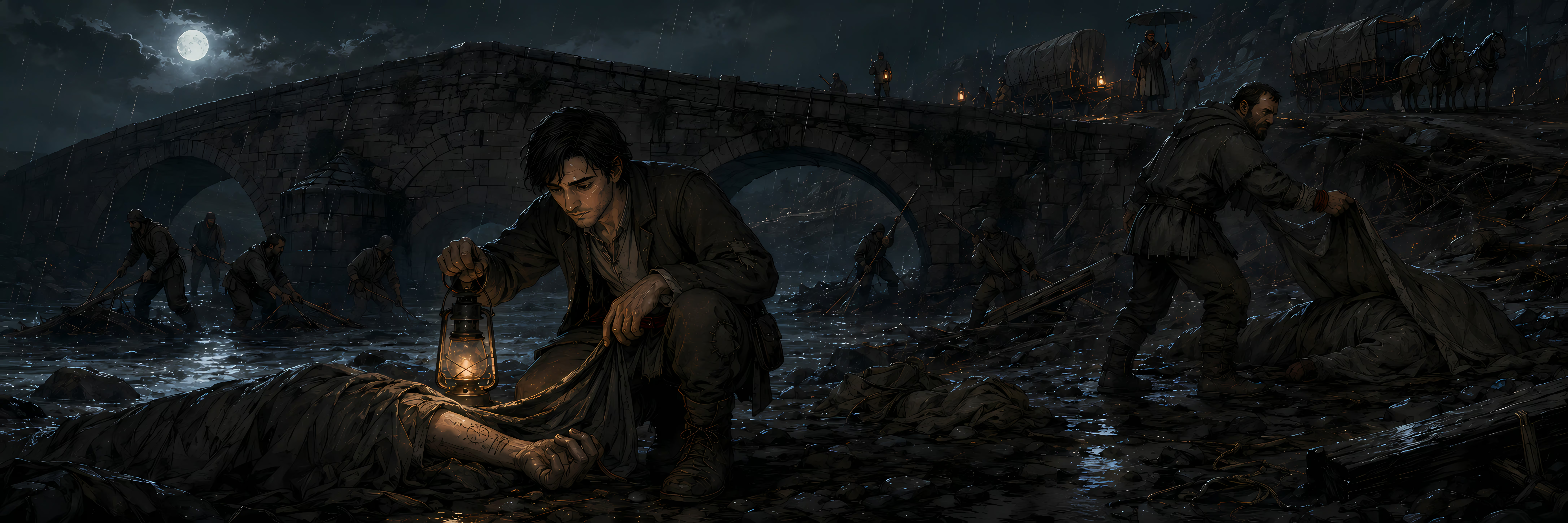
Three bodies were caught among it.
One of the new workers stopped.
— What do we do with them?
Without coming closer, Varek answered:
— Pull them from the channel and put them beneath the bridge. Someone will come for them when the rain eases.
The young man looked toward the place Varek had indicated.
It was a narrow stretch of wet stone beside the water, dark even in daylight. Old mud stains and scraps of cloth remained there from earlier levies.
It was not a burial place.
It was a place for waiting.
Garen put a rope in the young man’s hand.
— Hold tight.
The men began to work.
They fixed ropes around a mass of branches and dragged it away from the supports. Water surged through the moment part of the channel was freed, revealing the body of a man beneath it.
Garen covered him with a piece of cloth.
One of the merchants approached Varek with a scented handkerchief over his nose.
— Wash the stones before we pass.
Varek nodded.
Garen looked at the body, then at the cart’s clean wheels.
— So death doesn’t dirty the road.
No one answered him.
The workers carried the body beneath the bridge and placed it on the wet stones. One hand slipped from under the cloth, and the new worker pushed it back quickly, as though afraid it might seize him.
Elian moved to the other side of the channel.
He shifted a broken plank with his shovel, revealing the second body.
He knew the man.
The man had once worked in one of the mine passages, then disappeared weeks earlier after a long illness in his chest. The overseer had said he had left Graven in search of easier work.
But Elian knew he had not possessed enough money to reach the next village.
He bent to help cover him and noticed a small row of dark punctures on his wrist.
They formed a short line. They were not a random wound.
He asked the worker beside him:
— Have you seen anything like this before?
The man gave the marks a quick glance.
— A failed treatment, probably. Some Menders pierce the skin to draw the sickness out.
He pulled the cloth back over the hand.
— It didn’t draw the sickness out this time.
He took hold of one end of the body and walked away.
Elian remained where he was for a moment.
He had seen similar marks during earlier levies: small points or faded lines on the arms of people carried in by the water.
He was not sure why he remembered them.
Perhaps because they were arranged too carefully.
Perhaps because no one else cared.
They carried the second body beneath the bridge, then returned to the channel.
The third had caught near the roots of a small tree clinging to the rocks. At first, only a strip of pale cloth and a slender hand could be seen beneath the water.
Elian climbed down carefully and pulled the branches away.
She was a young woman he had never seen before. She did not wear the clothes of Graven, and she carried no bag, pendant, or anything else that revealed where she had come from.
Another worker helped him drag her into shallower water.
The man asked:
— Do you know her?
— No.
He dropped the cloth beside her, then left when Garen called him.
Elian was alone for a few seconds.
The soldiers watched the pace of the work while the merchants argued with Varek about the delay.
Elian lifted the young woman’s hand.
And stopped.
The mark on her wrist was not a scattering of separate points.
It was an incomplete circle, with three small punctures above it, two parallel lines below, and a short slash at one edge.
It looked old enough to have healed and regular enough not to be a failed attempt at treatment.
He tried to memorise it.
The circle.
The gap at its side.
The three points.
The two lines.
And the short slash.
Varek’s voice came from above the bridge:
— What is holding you up?
Elian raised his head.
— Her hand is caught.
He gripped the wrist and pulled it free of the roots, then covered the body.
As they lifted her, a small piece of parchment, folded many times, slipped from inside her belt.
The water nearly took it.
Elian placed his foot over it before the other worker noticed, then bent as though tightening the rope and hid it inside his coat.
They carried the young woman beneath the bridge and laid her beside the other two bodies.
Three bodies beneath the stone arch.
Three pieces of wet cloth.
And someone would come for them later, as someone was always said to do.
The workers continued clearing debris until the water flowed freely beneath the road again. Then they washed the stones quickly so the carts could pass without mud clinging to their wheels.
The first cart moved a few minutes later.
The merchant did not look at the bodies.
He inspected only the road, then ordered the driver onward.
Varek said:
— You’re finished. Return to your shifts or your homes.
Elian reached home shortly after first light.
Sera sat beside the hearth warming what remained of the previous night’s broth. She looked up at him, then at the water dripping from his coat.
— Take it off at the door.
This time he obeyed without argument.
He crossed to his bed and lifted one of its wooden boards.
Sera said:
— The notebook first?
— The broth won’t run away.
— And the notebook might?
He did not answer.
He took out a small notebook wrapped in cloth and sat beside the lamp.
It was not an orderly record, and it contained nothing anyone else would have considered important. Its pages were filled with names overheard in the tavern, the shapes of unusual nails, sketches of broken locks, and notes about things found in the mud whose reason for being recorded he had later forgotten.
He opened a blank page and drew the mark as he remembered it.
The circle came out crooked.
He placed the points too close together.
He rubbed them away with his fingertip and drew them again.
From beside the hearth, Sera asked:
— Did you find your gold?
He looked up at her.
— What a jester you are.
She returned to the broth.
Elian opened older pages.
He found three points he had drawn two months earlier after another cleanup levy. On a different page were two lines he had seen on the arm of a man carried in by a flood from the north.
The drawings were not identical.
But neither were they entirely different.
He took out the parchment he had removed from the young woman’s belt and laid it beside the lamp.
He unfolded it carefully.
Water had ruined most of the ink. Only the same mark remained clear, drawn at the edge of the sheet.
Beneath it were a few words:
After the third bell.
The old road.
Elian read them twice.
Then a third time.
He did not know whether they were an invitation, a warning, or an appointment the young woman had failed to reach.
But he knew the mark was no treatment scar.
He folded the parchment and placed it inside the notebook.
During the following nights, he went out to the eastern edge of Graven after his shift.
He found nothing on the first night.
On the second, he saw only a late cart and a drunken man who had lost the way home.
On the third night, he climbed the hills overlooking the old road and remained there beneath the light rain until he heard the third bell from the mine.
A long time passed without anything happening.
When he was about to leave, a light appeared among the trees.
Then a second behind it.
Then a third.
People came along the narrow road in dark cloaks, walking east without speaking.
Elian drew the notebook from inside his coat.
He looked at the mark one last time.
Then he closed it and descended from the hill to follow the lights.
The Cloaked Ones
Elian returned the notebook to his coat and climbed carefully down the hill.
The cloaked figures moved along the old road in an uneven line. They carried no banners and wore no distinguishing uniform, only dark cloaks against the rain and old shoes sinking into the mud.
They looked like workers returning from a distant village, or poor travellers seeking shelter before the night worsened.
Elian waited until the last of them had passed, then joined the rear of the group.
No one looked back at him.
He lowered his head and matched their pace. His dirty clothes and cheap coat were enough to make him seem one of them. In Graven, his appearance marked him as poor. Here, it was the best disguise he had.
They moved in silence.
No greetings. No names. No speech beyond brief whispers that never reached the end of the line.
After some distance they left the road and entered a narrow path between the trees. Elian tried to memorise what surrounded him: a split tree near the entrance, a long leaning rock, and a slope descending to the left.
He did not know where the path led.
But he wanted to know how to return from it.
A man walking ahead glanced back. Half his face was hidden beneath his hood.
He said:
— You’re late.
Elian replied:
— The road is flooded.
The man looked at the mud on his boots, then faced forward again.
After roughly half an hour they reached a rocky rise surrounded by trees. The lamps began disappearing one by one behind outcrops of stone until a low cave entrance, hidden at a distance by branches, came into view.
Two guards stood at the entrance.
Their cloaks resembled the others’, but the swords at their waists were cleaner than anything around them.
The first man passed forward.
A guard raised the lamp toward his face.
— Whom do you follow?
A brief answer came, and he was allowed inside.
The question was repeated for the next person.
Strange names.
The Silent Ones.
Those of the Red Thread.
And groups Elian had never heard of.
He felt the weight of the notebook beneath his coat.
He had not considered guards when he began following them. He had expected to watch the place from a distance, then return with what he had seen.
Now he stood in the middle of the line, with people behind him close enough to notice if he withdrew.
His turn came.
The guard raised the lamp until the light reached his eyes.
— Whom do you follow?
Elian remained silent.
He had no answer.
The guard looked at his face, then repeated the question more sharply:
— Whom do you follow?
Elian leaned one ear closer, pretending the rain had hidden the words.
— What did you say?
Annoyance crossed the guard’s face. He took a step nearer and raised the lamp close to Elian’s eyes.
— I asked: whom do you follow?
It gave Elian a few seconds.
He remembered the drawings hidden in his notebook, the marks he had seen on the bodies, and the circle that had appeared more than once beside the lines.
He did not know the true names of the groups, so he chose the name he had used in his notes.
He said:
— The People of the Two Slashes.
The guard’s gaze fixed on him.
He exchanged a quick look with his companion, then asked:
— Which batch?
Elian had not thought of a batch.
He stared into the lamplight for a moment and gave the first number that settled in his mind.
— The third.
The guards remained silent for several seconds.
The man behind Elian shifted impatiently, and at last the guard moved aside from the entrance.
— Go in.
Elian moved before he could change his mind.
The inner passage was narrow and damp. Black roots hung from its ceiling, and thin streams of water ran along its sides. Small lamps had been fixed between the rocks, but they were not enough to drive away the darkness.
After some distance the passage opened into a broad hollow inside the mountain.
It was neither an elegant headquarters nor a secure refuge.
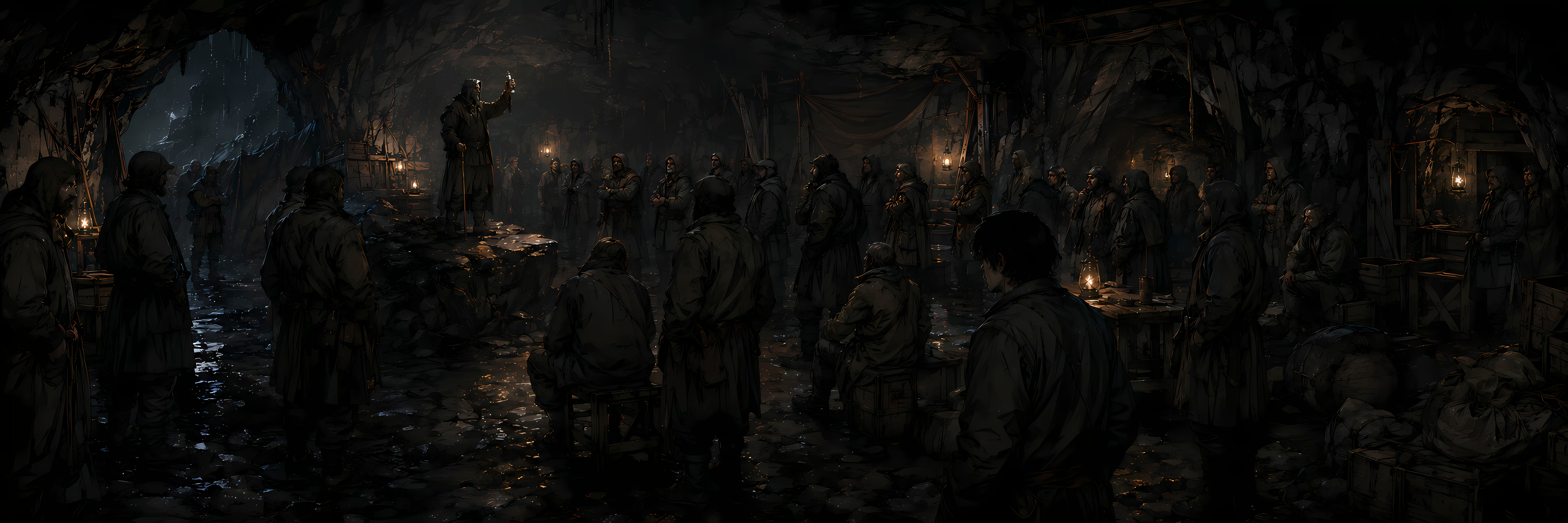
It was a poor cave tamed with whatever had been available: timbers supporting parts of the walls, heavy curtains dividing the corners, crates set on uneven ground, and tables made from boards that did not match.
Even so, the place was crowded.
Dozens stood in small groups. Labourers in ragged clothes, travellers with mud covering their boots, and men who concealed beneath their cloaks garments far more expensive than anything worn by the people of Graven.
Conversation moved in overlapping murmurs. A sentence rose here and another broke off there, and voices lowered whenever someone unfamiliar approached.
At first, Elian stood alone.
He moved closer to a group gathered beside a stone pillar. He heard only a few words before one of them noticed him, and the subject changed at once.
He crossed to a large crate where three men argued quietly. He caught only the names of places he did not know before one of them turned his back and closed the circle.
Elian could draw no closer.
Nor did he dare ask questions.
On the other hand, no one was especially interested in him.
That was what kept him safe.
He moved slowly around the edges of the chamber, trying to gather something useful from broken conversations, but he came away with only scattered words that led nowhere.
Before long, the voices began to fade of their own accord.
An elderly man moved toward a raised rock at one end of the chamber.
He walked with the support of a long staff capped in iron. His steps were not quick, but they opened a path through the crowd without his asking anyone to move.
He climbed the rock slowly, then turned toward the chamber.
In his other hand he carried a small bottle of dark glass, holding no more than a few doses of liquid.
He raised it toward one of the lamps.
The chamber fell silent.
He said:
— Before we begin, we have received an order for another shipment of this remedy.
Several heads shifted to see the bottle more clearly.
— It remains under trial and examination, but the results were sufficient for more to be requested. It has been agreed that the next shipment will be sent to Eiraf.
Elian heard the name of the city clearly.
He had never seen it, but he had heard cart drivers speak of it: a city larger than all the villages around Graven, whose gates received goods and merchants from distant roads.
The man continued:
— I know we lack hands. For that reason, no one will be forced to go. Whoever volunteers will have rendered us a good service and will receive a reward when the task is complete.
Murmurs began again.
Some men consulted one another. A hand rose on the left, then a second after a pause.
A third followed moments later.
Elian continued to watch the bottle.
He remembered the mark on the young woman’s wrist.
The piece of parchment that had led him to the old road.
And the city he had never left Graven to approach.
He could remain where he was, listen to the rest of the meeting, and return home with what he had learned.
But he wanted to see the remedy up close.
And he wanted to know where the shipment would go.
He raised his hand before giving himself enough time to withdraw it.
The old man looked at the four raised hands.
— That will do.
He pointed with his staff toward a side opening in the cave.
— Volunteers, go to the adjoining room. The task will be explained there.
Elian lowered his hand.
He disliked leaving the chamber before hearing the rest of the meeting, but after volunteering he could not remain without drawing attention.
He followed the other three men toward the side opening.
Behind them, the murmurs spread again among the gathered crowd.
The Shipment to Eiraf
The adjoining room was smaller than the chamber, with space for only a wooden table and several mismatched stools. An old map had been fixed to the table with stones at its corners, and a man stood beside it waiting for them.
The four men entered.
The curtain closed behind them.
The man did not ask their names.
Nor did he give his own.
He pointed to the road drawn on the map.
— Two carts will leave at first light. They carry a shipment of remedies ordered especially for a merchant in Eiraf.
He traced a finger along the road running east.
— In the records, the crates contain nothing but dried herbs and salves for fever and aching joints. That is what you will say if questioned.
One of the volunteers raised his head.
— Who is the merchant?
The man looked at him.
— You do not need to know.
The volunteer fell silent.
The man continued:
— You will enter through the southern gate, then go to a warehouse near it. Two men will meet you, each wearing a grey band around his left forearm. Give the crates to them, take whatever they give you, and leave.
He pointed to a small place on the map beside the city wall.
— Do not mention the remedy. Do not ask about the owner of the warehouse. Do not prolong your talk with the guards or anyone on the road. You are labourers hired to transport medicinal herbs, and that is all you know.
Elian looked at the other three men.
Each sat a little apart from the others, as though the meeting had not yet made them a group.
Names were unnecessary here.
Perhaps ignorance of them was part of the task.
The man took out a folded paper and a small seal and placed them before one of the volunteers.
— You are responsible for the route.
The man took the paper without opening it.
— The rest of the instructions are written here. The overseer and the carts will be waiting for you in the morning, and he will explain anything else when needed.
Elian did not know which of them would be the overseer, and he did not ask.
The man pointed to a narrow passage behind the curtain.
— Leave by the rear way. Do not return to the chamber. The meeting no longer concerns you.
Then he added:
— Return at first light to the stone passage south of the old road. Do not be late, and do not arrive together.
He extinguished the small lamp above the map.
— Your part here is finished.
The four men left through the rear passage.
It was narrower than the first entrance and descended between the rocks until it reached a remote part of the forest. There were no lamps, and they had to follow the faint light coming from the end of the passage.
They emerged one after another into the rain.
No one spoke.
They separated at the road, each man taking a different direction.
Elian walked toward Graven feeling that luck alone had brought him into the cave, then led him out again before anyone asked a question he could not answer.
He did not know what the remedy was.
He did not know why its mark had been on the wrist of a dead young woman.
But now he knew the shipment would leave in the morning, and that it was going to a merchant inside Eiraf.
And he was one of the men who would carry it.
He reached home shortly before dawn.
Agatha was awake beside the hearth, while Sera sat wrapping a strip of cloth around her hair in preparation for the day.
Sera looked up at him.
— The cleanup levy ran late.
Elian took off his coat at the door.
— They were deciding how to reward me.
Sera’s hand stopped.
— You?
— For my diligence in the levies. They chose me to go to Eiraf and fetch some tools the mine needs.
She watched him for a moment, then said:
— I always knew the mud would open the gates of cities to you one day.
Elian sat beside the hearth.
— Try not to weep with pride.
Agatha said:
— When do you leave?
— At first light.
— When do you return?
— After the tools arrive.
Agatha did not ask how a nighttime cleanup levy had become a journey toward Eiraf. She pushed toward him a piece of bread left from the previous night.
— Take it with you. And never believe anyone who tells you a road is shorter than it looks.
Elian took it and placed it beside his coat.
Sera said:
— Will they give you an entire cart, or make you carry the tools on your back as a reward?
He looked at her.
— Burying you beneath the mine ash still sounds like a good idea.
She smiled as she returned to tying her hair.
— Come back from Eiraf first. Then try.
Elian slept only briefly.
The notebook remained beneath the board of his bed, and the piece of parchment stayed inside its pages. He did not take it with him. He did not want to carry anything that connected him to the young woman if he was searched on the road.
At the first morning bells, he put on his coat and left the house.
Graven woke in the same way it never slept: workers emerging from the mine, others descending into it, and carts waiting for ore beside the road.
Elian walked toward the stone passage south of the old road.
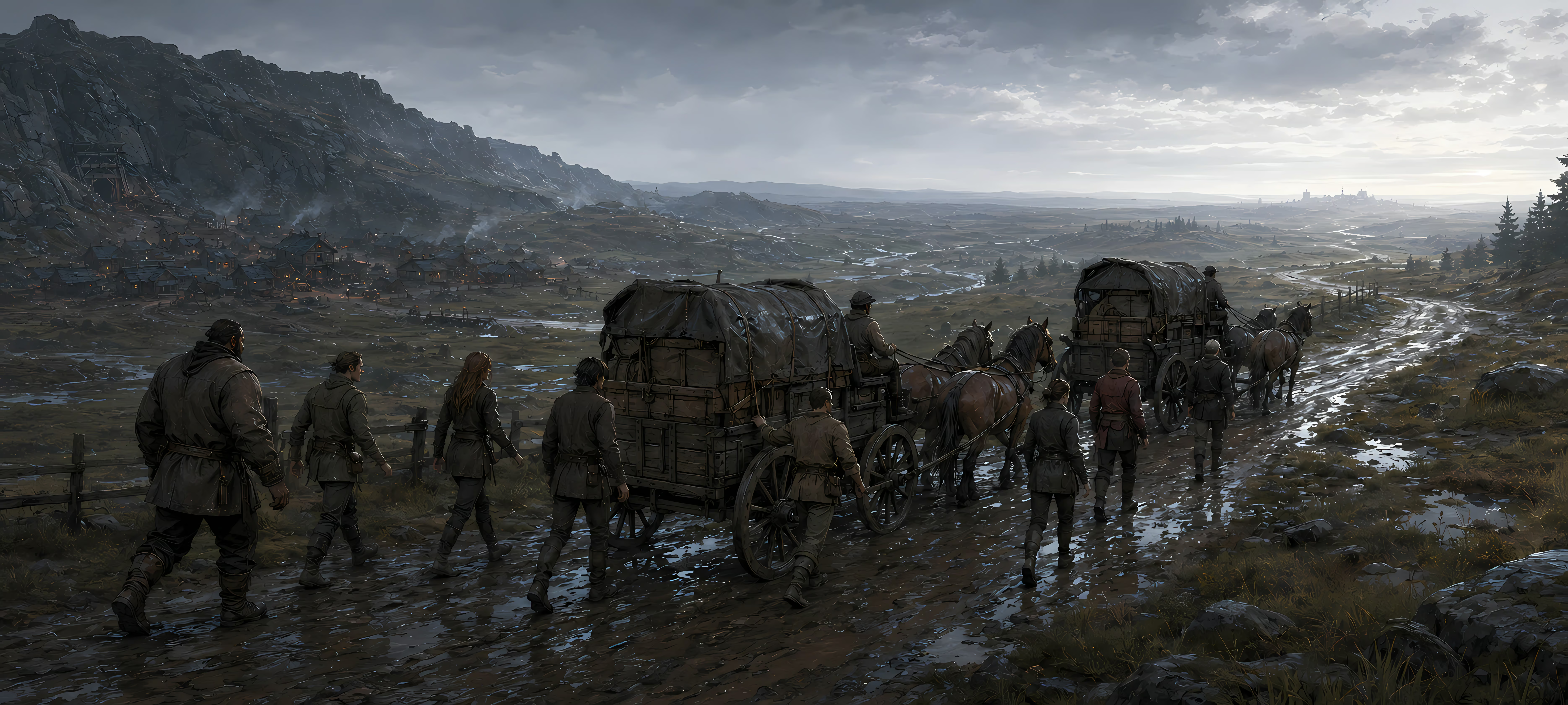
The two carts appeared between the trees.
The crates were covered in heavy cloth and secured with rope. The three men he had seen in the room stood beside them, and one held the folded paper and the small seal.
Elian did not know their names.
No one asked for his.
He approached the cart and placed the piece of bread inside his coat.
Behind him, a new shift began in the mine of Graven.
Ahead, the road stretched toward Eiraf.
Chapter Comments
All published comments appear here. New submissions are reviewed before publication.
Loading comments…